
Long Term Care Insurance Policies
Highly qualified and motivated professionals
In the United States, seven out of ten seniors over age 65 will need some type of long-term care services during their lifetime, and approximately one-third of Americans will require care in a skilled nursing facility at some point in their lives due to changes in mobility, cognitive function, or both. When an individual’s level of mobility or cognitive function begins to change, they usually require assistance to perform normal activities of daily living (ADLs), such as bathing, eating, and getting dressed. Aging may gradually reduce one’s ability to comfortably do certain activities, but an individual may require assistance with daily activities due to a serious illness, while recovering from an injury, or after being discharged from the hospital following surgery. Often, those healing from medical conditions or procedures require short-term assistance for a few months; in other cases, care may be required for a lifetime.
Qualifying Event for Long Term Care
Mini-mental State Exam
Cognitive Tests
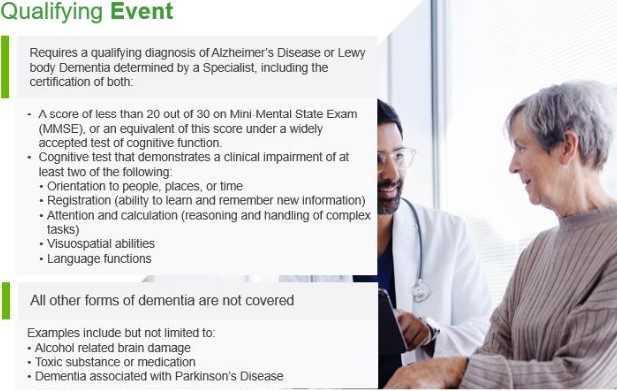
Lewy Body Dementia
Parkinson's Disease
Paying For Long-term Care Services
There are four common methods for paying for long-term care services. These are:
1. Medicare
2. Medicaid
3. Personal Assets and Savings
4. Long-term Care Insurance


Medicare is a federal program for persons over age 65 and for peopled age 65 with disabilities. Medicare generally does not cover log-term care services. However, Medicare will help to pay for short stay in a skilled nursing facility, for hospice care, or for home care under certain conditions.
While Medicaid will par for most long-term care expenses for eligible low-income persons, it is often difficult to qualify for the government services. To be eligible, a person must meet both the general requirements as well as meet the financial requirements.
Paying for long-term care out of personal savings can be an option for some. However, it depends on how long the services are needed, short period of time or an extended one. However, paying for long-term care out of personal savings can be devastating for couples who have been saving assets together for many years to pay for their needs during retirement.
Long -term care insurance is an option that can mitigate the risk of needing and having to pay for long-term care for an extended period of time, including personal and custodial care in a variety of settings. Long-term care insurance pays for home health care, nursing home stays, and hospice care. Long-term care insurance policies have many choices, limitations, and costs that need to be considered.
Texas Continuing Education
Certificate of Completion
Certificate on Long Term Care Insurance is essential for Agents/Brokers to counsel and offer Long Term Care insurance policies to consumers in the State of Texas. It is important for the Agent/Broker to be updated on the rules and regulations that protect consumer's best interest at all times.
Contact Us, We Are Here For You
3404 Spring Meadow Lane, Flower Mound, Texas 75028 (Main Office)
(469)265-1033 / (214)809-8552
DEAJ Insurance and Investments Consulting is currently seeking approval as a Registered Investment Adviser (RIA) with Texas State Securities Board. The information on this website pertaining to any investment product(s) or investment advise are for informational purposes only and does not constitute an offer to sell or buy any security or investment advisory services. Investment advisory services can only be provided after the firm is registered and a written advisory agreement is executed.